For clinical, educational, or research teams who need multiple, brief measures of reading, spelling, and math from age 5 through 85+, the WRAT4 offers two alternate forms used for retesting within short intervals to assess progress, or to combine into a single more comprehensive measure to help identify learning disabilities in small groups or with individuals. See our Guidance on using this assessment remotely.A newer version of the WRAT is available
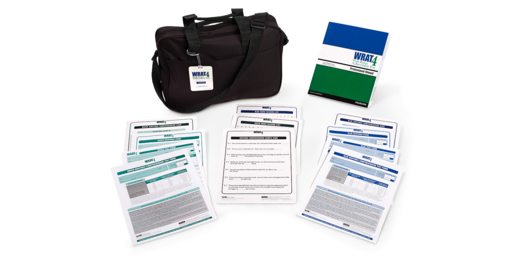
 Activate to view the image in zoom mode
Wide Range Achievement Test | Fourth Edition
WRAT4
For clinical, educational, or research teams who need multiple, brief measures of reading, spelling, and math from age 5 through 85+, the WRAT4 offers two alternate forms used for retesting within short intervals to assess progress, or to combine into a single more comprehensive measure to help identify learning disabilities in small groups or with individuals. See our Guidance on using this assessment remotely.A newer version of the WRAT is availableOverview
Product Details
- Age range:
- Individuals 5 - 94
- Scores/interpretation:
- Standard scores, percentile ranks, stanines, normal curve equivalents, grade equivalents, and Rasch ability scaled scores are provided.
- Qualification level:
- B
- Completion time:
- Approximately 15-25 minutes for ages 5 – 7; approximately 35-45 minutes for ages 8 and up
- Administration:
- Paper and pencil
- Scoring options:
-
Hand scoring
- Norms:
- This academic skills assessment was standardized on a national sample of over 3,000 individuals ranging in age from 5 to 94. Scores were developed for both age- and grade-referenced groups.
- Telepractice:
- Guidance on using this test in your telepractice
The WRAT4 serves as an excellent initial academic achievement evaluation, re-evaluation, or progress measure for any student. Use with individuals or small groups to identify those requiring a more comprehensive academic achievement evaluation.
Features and Benefits
- The WRAT4 improvements include the addition of a Sentence Comprehension subtest.
- The Blue and Green forms can be used interchangeably with comparable results, permitting retesting within short periods of time.
- Alternate forms can also be combined into a single examination for a more comprehensive academic skills assessment.
WRAT4 Test Structure
The WRAT4 provides derived scores and interpretive information for four subtests:
- Word Reading measures word decoding through letter identification and word recognition.
- Reading Comprehension measures the ability to identify the meaning of words and to comprehend the ideas and information in a sentence using a modified cloze technique.
- Spelling evaluates an individual's ability to identify sounds and transfer them into written form from dictated letters and words.
- Math Computation measures an individual's ability to count, identify numbers, solve simple oral math problems, and calculate written math problems. Problems are presented in a range of domains, including arithmetic, algebra, geometry, and advanced operations.
- A Reading Composite score is created by combining the Word Reading and Sentence Comprehension standard scores.
Additional Psychometric Information
- Alternate-form immediate retest reliability coefficients ranged from .78 to .89 for an age-based sample and from .86 to .90 for a grade-based sample.
- The alternate-form delayed (approximately 30 days) retest study indicated that practice effects are quite small. Mean score differences of 0.4-2.2 were found for an age-based sample. Differences of 0.1-0.5 were found for a grade-based sample.
- Validity evidence is determined from the content and structure of the test battery, studies with special groups of individuals, and correlations with other widely used achievement and cognitive ability measures. These include:
- KTEA-II Comprehensive
- KTEA-II Brief
- WISC®-IV
- WASI™
- RIAS™
- WAIS®-III
- WIAT®-II
- SB5
- WJ®-III
- WRAT-Expanded
- KBIT
- WRIT